Keyword cannibalization is one of the most common silent SEO problems on casino affiliate sites — and one of the most damaging once it takes hold at scale. It happens when two or more pages on the same site target the same keyword or closely related keyword intent, causing Google to split ranking signals between the competing pages rather than concentrating them on a single definitive page. The result: both pages rank weakly for the target keyword rather than one page ranking strongly. For casino affiliate sites that have grown organically over months or years — adding review pages, bonus pages, and comparison pages without a coordinated keyword map — cannibalization is almost inevitable and frequently explains why certain commercial keyword positions remain stubbornly mid-SERP despite significant link building.
- How Keyword Cannibalization Develops on Casino Affiliate Sites
- Pattern 1 — Review Pages vs Category Pages Competing
- Pattern 2 — Payment Method Pages Overlapping
- Pattern 3 — Bonus Pages Proliferation
- How to Diagnose Keyword Cannibalization on a Casino Site
- GSC Method — The Fastest Diagnosis
- Ahrefs Method — Bulk Diagnosis
- The Three Fixes — Which to Apply When
- Fix 1 — Canonical Tag: When Both Pages Should Exist
- Fix 2 — Content Merge + 301 Redirect: When One Page Should Absorb the Other
- Fix 3 — Differentiate Intent: When Both Pages Can Be Rescued
- Preventing Cannibalization on Growing Casino Sites
- FAQ — Keyword Cannibalization Casino Sites
- How do I know if my casino pages are cannibalising each other?
- Should I delete the weaker cannibalising page?
- How long does fixing cannibalization take to improve rankings?
How Keyword Cannibalization Develops on Casino Affiliate Sites
Casino affiliate sites develop cannibalization through three specific patterns that are each predictable and fixable.
Pattern 1 — Review Pages vs Category Pages Competing
A site has a category page targeting “Best Casino UK” and also has a “Casino Review Roundup” blog post also targeting “Best Casino UK”. Both pages contain lists of top UK casinos. Both use similar H1 and meta title structures. Google sees two pages with equivalent intent signals and divides ranking authority between them — neither reaches the competitive position that either could achieve alone if it received all of the domain’s authority for that cluster. This pattern is extremely common on casino affiliate sites that have added “best of” blog content alongside existing category pages without differentiating intent.
Pattern 2 — Payment Method Pages Overlapping
A site creates a “UPI Casino India” category page and separately creates a blog post “How to Deposit at Casino Using UPI”. Both pages contain information about UPI casino options. Both rank for variations of “UPI casino” queries. The category page should own the transactional intent (“which casinos accept UPI”). The blog post should own the informational intent (“how does UPI casino deposit work”). When both pages address both intents equally, they compete for the same SERP positions rather than each dominating its specific intent cluster.
Pattern 3 — Bonus Pages Proliferation
This is the most aggressive cannibalization pattern on casino affiliate sites: a site creates “Casino Bonus UK”, “Casino Welcome Bonus UK”, “Casino Sign Up Bonus UK”, “New Casino Bonus UK”, and “Casino Bonus Offers UK” as separate pages — each targeting a keyword variant it considers distinct but that Google evaluates as equivalent search intent. From Google’s perspective, all five pages are trying to rank for “casino bonus UK” — it distributes authority across five pages instead of consolidating it on one definitive bonus comparison page.
How to Diagnose Keyword Cannibalization on a Casino Site
GSC Method — The Fastest Diagnosis
Google Search Console shows which pages are receiving impressions for each query. Export Performance data, filter to a specific commercial target keyword (“casino bonus UK”), and check how many different pages receive impressions for that query. If two or more pages appear in the impressions data for the same target keyword — especially if both appear with meaningful impression volumes — you have confirmed cannibalization for that keyword.
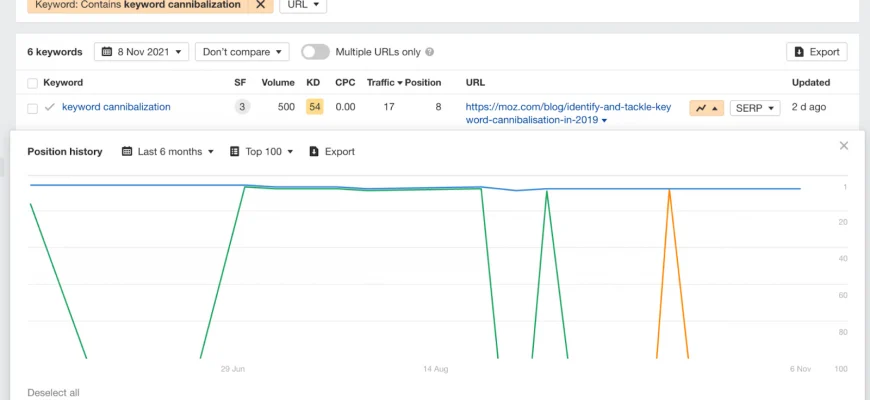
The most telling signal in GSC cannibalization data: position fluctuation on the target keyword correlates with which page Google is temporarily deciding to rank. The position switches between 5 and 15 for the keyword across weeks, but the switching is between two different URLs rather than the same URL fluctuating. This URL-switching pattern in GSC is the clearest confirmation of active cannibalization.
Ahrefs Method — Bulk Diagnosis
In Ahrefs Site Explorer, use the Organic Keywords report filtered to show only keywords where your site has multiple ranking URLs. Ahrefs flags keywords where two or more of your site’s pages rank for the same query within the top 100 positions. For casino sites with large page counts, this report typically reveals dozens of cannibalization instances across commercial keyword clusters. Export the full list, prioritise by the commercial value of the affected keywords, and plan fixes starting from the highest-value cannibalized pairs.
The Three Fixes — Which to Apply When
Three technical approaches fix keyword cannibalization. The correct fix depends on the specific pages involved, their relative link authority, and the intent differentiation between them.
Fix 1 — Canonical Tag: When Both Pages Should Exist
Use a canonical tag when both pages serve legitimate but related purposes, and one is clearly the primary page for the target keyword. Example: a “Casino Bonus UK” category page (primary, should rank) and a “Best Casino Bonus UK 2026” blog post (secondary, provides timely content but cannibalises the category). Add a canonical tag on the blog post pointing to the category page: <link rel="canonical" href="https://example.com/casino-bonus-uk/">. This tells Google to consolidate ranking signals to the category page while keeping the blog post accessible and indexable for freshness signals.
Fix 2 — Content Merge + 301 Redirect: When One Page Should Absorb the Other
Use merge-and-redirect when two pages are covering essentially the same intent with similar content and both cannot be meaningfully differentiated. Process: identify the stronger page (higher backlink count, higher average position, more comprehensive content), enhance it with the best content from the weaker page, and 301 redirect the weaker page URL to the stronger one. The 301 redirect consolidates all link equity from the redirected page to the destination. For casino bonus pages (five near-duplicate UK bonus pages as above): merge the best content from all five into the single strongest page and 301 redirect the remaining four URLs to it.
The benefit of merge-redirect over canonical for this scenario: a 301 redirect permanently consolidates all link authority from the redirected pages to the surviving page, producing a measurable authority increase on the destination page. Canonical tags consolidate ranking signals but the non-canonical page’s link equity is not fully transferred in the same way.
Fix 3 — Differentiate Intent: When Both Pages Can Be Rescued
Use intent differentiation when both pages have significant link authority and can be meaningfully differentiated by search intent rather than merged or canonicalised. For the casino review page vs blog roundup scenario: rewrite the category page to own the transactional intent purely (casino list, comparison table, CTA to visit each casino, minimal editorial content). Rewrite the blog post to own the informational intent purely (editorial perspective, detailed analysis, comparison criteria explanation, expert recommendations). The two pages no longer compete because they serve different intent layers of the same broad keyword cluster.
Preventing Cannibalization on Growing Casino Sites
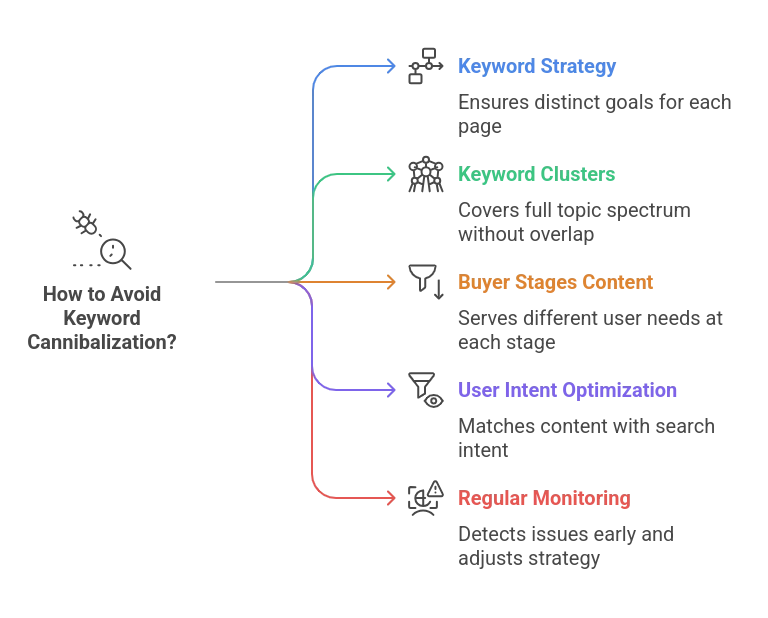
The correct prevention mechanism is a keyword map maintained before any new page is published. Each target keyword is assigned to exactly one URL — the page that owns that keyword’s intent. Before producing any new page, check whether the target keyword is already assigned to an existing page. If it is, the new content should either differentiate by targeting a genuinely different intent (informational vs transactional within the same broad keyword) or expand the existing page rather than creating a new competing one.
For casino affiliate sites that have already grown without a keyword map — the situation most established affiliates are in — a retroactive keyword map audit is required before continuing to publish. Mapping all existing pages against their ranking keywords in GSC identifies every active cannibalization instance and provides the foundation for a cleanup campaign before continuing to add new pages that risk adding more cannibalization on top of existing problems.
Our SEO audit service includes a full keyword cannibalization analysis for existing casino sites — identifying every cannibalising pair ranked by commercial value, recommending the correct fix (canonical, merge-redirect, or intent differentiation) for each, and producing a prioritised implementation plan. Our on-page SEO service implements the fixes. For new site builds, keyword mapping is built into the affiliate site architecture as a standard component.
FAQ — Keyword Cannibalization Casino Sites
How do I know if my casino pages are cannibalising each other?
Check GSC Performance data for your target keyword and look for multiple pages receiving impressions. If two pages both show impressions for the same query, cannibalization is confirmed. In Ahrefs, the Organic Keywords report filtered for multiple ranking URLs per keyword shows all cannibalization instances across the site simultaneously.
Should I delete the weaker cannibalising page?
Rarely — delete only when the page has zero backlinks, zero organic traffic, and no unique content value. In most cases, a 301 redirect from the weaker page to the stronger page is better than deletion because the redirect preserves and transfers any residual link equity the weaker page has accumulated. Deletion loses that equity permanently.
How long does fixing cannibalization take to improve rankings?
Canonical tag implementation: GSC typically reflects consolidated ranking signals at two to four weeks after Google re-crawls both pages. Merge-redirect: the full link equity consolidation from 301 redirects takes four to eight weeks to fully manifest in rankings as Google processes the redirect chain. Intent differentiation through content rewriting: re-evaluation of the differentiated pages typically takes three to six weeks after the content changes are re-crawled.
Tags: #KeywordCannibalization #CasinoSEO #iGamingSEO #DuplicateContent #CanonicalTag #CasinoAffiliate #SEOFix #KeywordMapping #SEOAudit #iGamingMarketing